Jackery Explorer 1000 v2 — 1,070 Wh US version
A finite-energy battery station for selected portable loads. This guide covers the 1,070 Wh, 120 V JE-1000D specification documented by Jackery, with particular attention to model-version differences.
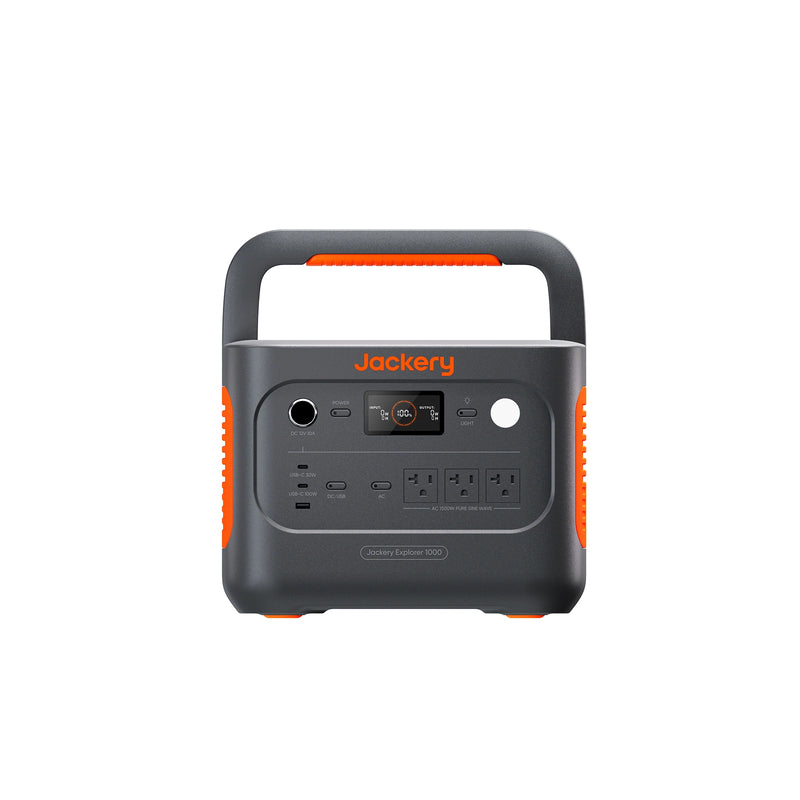 IMAGE: Jackery
A buyer who has measured a short list of essential devices and can recharge the station between uses.
Jackery's current sales page includes both 1,024 Wh and 1,070 Wh specifications. Confirm the actual version, voltage and supplied accessories; do not infer them from the Explorer 1000 v2 name alone.
Resolve the version before comparing
The model name is currently insufficient to identify every specification. At our check, the official sales page displayed newer 1,024 Wh material alongside tables for the 1,070 Wh unit. This article therefore uses the specific 1,070 Wh US configuration in Jackery's support documentation. Ask the seller for the capacity and output voltage on the actual unit, plus a matching manual, before ordering.
An apparently small version difference can matter when comparing ports, recharge claims and accessories. Keep a copy of the exact listing and check the box on delivery. Treat a regional review or a bundled solar-generator description as a starting point for questions, rather than evidence that another package includes the same hardware.
Separate energy from output power
Capacity in watt-hours and output in watts answer different questions. The first describes stored energy; the second limits how much load can run at once. Jackery documents a 1,500 W combined AC rating for this version. Three sockets do not provide three separate 1,500 W budgets. A brief surge allowance also should not be treated as a continuous operating limit.
As an arithmetic illustration, 1,070 Wh divided by a constant 100 W load is 10.7 hours before conversion losses and the station's own consumption. That is not a tested runtime or a promise. Real planning needs the device's measured draw, intermittent operation, the selected output and a reserve. Heating loads can consume a battery budget quickly even when they stay below the inverter limit.
Choose a realistic recharge and placement plan
Think through the second day as carefully as the first. A battery that covers an evening may be unsuitable for an extended outage if there is no practical recharge source. Solar-panel wattage is a rated input opportunity, not a guaranteed daily harvest. Shade, panel orientation, weather and electrical compatibility affect what reaches the battery. Read the permitted voltage and connection rules before choosing panels.
Jackery's support information says this model does not support add-on battery packs and is not waterproof or dustproof. Those points make protected placement and sizing at purchase important. The documented backup switchover is not an uninterrupted, zero-millisecond supply. Equipment that cannot tolerate interruption needs its own compatibility assessment and an appropriate backup design.
- List the intended devices and measure their combined power requirements.
- Check startup requirements separately from normal running draw.
- Confirm a matching US manual, panel connectors and included cables.
- Use the manufacturer's operating and storage instructions for the actual version.
Sources & verification
Manufacturer information and primary references. Specifications can vary by region, model and revision; confirm the exact listing before buying.
Choose the exact model and regional version before following a shopping link.
Explore Jackery products